Thursday, March 31, 2011

Thursday, March 24, 2011
White House defends Libya response
March 24, 2011 10:57 p.m. EDT

Washington (CNN) -- The Obama administration strongly defended its handling of the Libyan crisis Thursday, drawing a clear line between military and political objectives while dismissing criticism that it has failed to adequately consult with members of Congress.
"We are not engaged in militarily-driven regime change," White House Press Secretary Jay Carney told reporters. Instead, the administration is engaged in "time-limited, scope-limited" action with other countries to protect civilians from forces loyal to strongman Moammar Gadhafi.
American forces will be transitioning to a "support and assist" role in the international coalition within a matter of days, he promised. U.S. ground troops will not be sent into Libya, he stressed.
Later in the day, NATO Secretary-General Anders Fogh Rasmussen announced that NATO members will take over enforcement of the no-fly zone as soon as Sunday. But he stopped short of interpreting that mandate as a license to attack pro-Gadhafi forces who may be threatening unarmed civilians. Nor did he say its goal was to effect regime change.
President Barack Obama has said the administration's ultimate objective is Gadhafi's removal from power. U.S. officials have indicated they hope Gadhafi will be removed quickly by forces currently loyal to him, though they haven't publicly called for a coup.
Carney listed a series of recent meetings, hearings and briefings by top officials -- including the president -- with members of Congress on Libya. The list was produced in response to accusations by House Speaker John Boehner, R-Ohio, and others that the White House failed to properly consult with legislators before launching the Libyan mission.
Boehner sent a letter to the president Wednesday complaining that "military resources were committed to war without clearly defining for the American people, the Congress, and our troops what the mission in Libya is and what America's role is in achieving that mission."
Carney said the administration has "endeavored to answer (Boehner's) questions already," and noted that the speaker received a classified intelligence briefing on March 14. He also accused some critics of being "perhaps driven by politics."
Carney said the president will continue to speak out on Libya "with relative frequency."
A Republican source, meanwhile, told CNN that Secretary of State Hillary Clinton, Defense Secretary Robert Gates, Joint Chiefs of Staff Chairman Adm. Mike Mullen, and National Intelligence Director James Clapper will deliver a classified briefing to members of Congress on March 30.
Hearings were also scheduled for the House Foreign Affairs and House Armed Services committees next week, according to a Democratic source.
Asked about the financial cost of the mission, Carney said expenses should be covered by existing Pentagon funds. But he told reporters, "I don't want to get into numbers. I'm not an economist."
While the White House insists it has been -- and will continue to be -- responsive to questions about the Libyan mission, critics on the right and the left remain unmollified.
Shortly after Carney spoke to reporters, Brendan Buck, a spokesman for Boehner, released a statement arguing that "it's fair to say the (speaker's) letter wouldn't have been necessary if the speaker -- and the American people -- had received answers."
Buck also said it's "important to note that an update on conditions in Libya is far different than a briefing on military operations under consideration."
One key House Republican called Wednesday for a withdrawal of U.S. forces, arguing that Obama had failed to rally public support for military action.
"Mr. President, you have failed to state a clear and convincing explanation of the vital national interest at stake, which demands our intervention in Libya," said Rep. Candice Miller, R-Michigan. "You have failed to state a clearly defined mission for our military to defend that interest. ... I believe you must pull our forces from the coalition immediately."
Rep. Tom McClintock, R-California, contends the president violated the 1973 War Powers Act and other constitutional restrictions on authorizing military action.
The president's actions constitute "a usurpation of constitutional powers clearly and solely vested in the United States Congress and is accordingly unlawful," McClintock said Wednesday.
Some liberal Democrats have also expressed unease with the intervention, particularly in regard to the relative lack of congressional consultation and the prospects for an open-ended conflict.
Arizona Rep. Raul Grijalva and California Reps. Barbara Lee, Mike Honda and Lynn Woolsey released a statement earlier in the week arguing that "the United States must immediately shift to end the bombing in Libya."
"We will fight in Congress to ensure the United States does not become embroiled in yet another destabilizing military quagmire in Libya with no clear exit plan or diplomatic strategy for peace," they said.
Top Senate Democrats, however, continue to defend the administration, insisting that Obama moved methodically and carefully to assemble a strong international coalition capable of saving innocent lives and reinforcing the broader Middle East reform movement.
Some analysts have echoed complaints about what they insist was unclear administration guidance about ultimate U.S. goals in Libya and the methods being used in pursuit of those objectives.
Obama has been "fairly muddy in what he's said," Max Boot, a senior fellow at the Council on Foreign Relations, argued Wednesday. The president has been "reacting frantically" to events and "being pulled hither and yon."
Boot predicted air power would not be sufficient to knock out the Gadhafi regime, and warned of a "protracted and costly stalemate" if the United States doesn't send in military advisers to help arm and train the rebels.
Obama may be hoping for a palace coup, he said, but "I wouldn't bet on it."
Boot also stressed the need for more planning for a post-Gadhafi Libya. There's a "real danger of chaos" and protracted tribal warfare if Gadhafi falls, he said. Al Qaeda may be able to exploit such a situation, he warned.
He blasted the White House for "not really preparing the American people for the possibility that this could be a protracted and expensive conflict."
"We are not engaged in militarily-driven regime change," White House Press Secretary Jay Carney told reporters. Instead, the administration is engaged in "time-limited, scope-limited" action with other countries to protect civilians from forces loyal to strongman Moammar Gadhafi.
American forces will be transitioning to a "support and assist" role in the international coalition within a matter of days, he promised. U.S. ground troops will not be sent into Libya, he stressed.
Later in the day, NATO Secretary-General Anders Fogh Rasmussen announced that NATO members will take over enforcement of the no-fly zone as soon as Sunday. But he stopped short of interpreting that mandate as a license to attack pro-Gadhafi forces who may be threatening unarmed civilians. Nor did he say its goal was to effect regime change.
President Barack Obama has said the administration's ultimate objective is Gadhafi's removal from power. U.S. officials have indicated they hope Gadhafi will be removed quickly by forces currently loyal to him, though they haven't publicly called for a coup.
Carney listed a series of recent meetings, hearings and briefings by top officials -- including the president -- with members of Congress on Libya. The list was produced in response to accusations by House Speaker John Boehner, R-Ohio, and others that the White House failed to properly consult with legislators before launching the Libyan mission.
Boehner sent a letter to the president Wednesday complaining that "military resources were committed to war without clearly defining for the American people, the Congress, and our troops what the mission in Libya is and what America's role is in achieving that mission."
Carney said the administration has "endeavored to answer (Boehner's) questions already," and noted that the speaker received a classified intelligence briefing on March 14. He also accused some critics of being "perhaps driven by politics."
Carney said the president will continue to speak out on Libya "with relative frequency."
A Republican source, meanwhile, told CNN that Secretary of State Hillary Clinton, Defense Secretary Robert Gates, Joint Chiefs of Staff Chairman Adm. Mike Mullen, and National Intelligence Director James Clapper will deliver a classified briefing to members of Congress on March 30.
Hearings were also scheduled for the House Foreign Affairs and House Armed Services committees next week, according to a Democratic source.
Asked about the financial cost of the mission, Carney said expenses should be covered by existing Pentagon funds. But he told reporters, "I don't want to get into numbers. I'm not an economist."
While the White House insists it has been -- and will continue to be -- responsive to questions about the Libyan mission, critics on the right and the left remain unmollified.
Shortly after Carney spoke to reporters, Brendan Buck, a spokesman for Boehner, released a statement arguing that "it's fair to say the (speaker's) letter wouldn't have been necessary if the speaker -- and the American people -- had received answers."
Buck also said it's "important to note that an update on conditions in Libya is far different than a briefing on military operations under consideration."
One key House Republican called Wednesday for a withdrawal of U.S. forces, arguing that Obama had failed to rally public support for military action.
"Mr. President, you have failed to state a clear and convincing explanation of the vital national interest at stake, which demands our intervention in Libya," said Rep. Candice Miller, R-Michigan. "You have failed to state a clearly defined mission for our military to defend that interest. ... I believe you must pull our forces from the coalition immediately."
Rep. Tom McClintock, R-California, contends the president violated the 1973 War Powers Act and other constitutional restrictions on authorizing military action.
The president's actions constitute "a usurpation of constitutional powers clearly and solely vested in the United States Congress and is accordingly unlawful," McClintock said Wednesday.
Some liberal Democrats have also expressed unease with the intervention, particularly in regard to the relative lack of congressional consultation and the prospects for an open-ended conflict.
Arizona Rep. Raul Grijalva and California Reps. Barbara Lee, Mike Honda and Lynn Woolsey released a statement earlier in the week arguing that "the United States must immediately shift to end the bombing in Libya."
"We will fight in Congress to ensure the United States does not become embroiled in yet another destabilizing military quagmire in Libya with no clear exit plan or diplomatic strategy for peace," they said.
Top Senate Democrats, however, continue to defend the administration, insisting that Obama moved methodically and carefully to assemble a strong international coalition capable of saving innocent lives and reinforcing the broader Middle East reform movement.
Some analysts have echoed complaints about what they insist was unclear administration guidance about ultimate U.S. goals in Libya and the methods being used in pursuit of those objectives.
Obama has been "fairly muddy in what he's said," Max Boot, a senior fellow at the Council on Foreign Relations, argued Wednesday. The president has been "reacting frantically" to events and "being pulled hither and yon."
Boot predicted air power would not be sufficient to knock out the Gadhafi regime, and warned of a "protracted and costly stalemate" if the United States doesn't send in military advisers to help arm and train the rebels.
Obama may be hoping for a palace coup, he said, but "I wouldn't bet on it."
Boot also stressed the need for more planning for a post-Gadhafi Libya. There's a "real danger of chaos" and protracted tribal warfare if Gadhafi falls, he said. Al Qaeda may be able to exploit such a situation, he warned.
He blasted the White House for "not really preparing the American people for the possibility that this could be a protracted and expensive conflict."
"The public and the administration should not be going into this with rose-colored blinkers on," Boot said.
NTSB: Air traffic controller fell asleep, leaving planes on their own
March 24, 2011 11:09 p.m. EDT
The controller, a 20-year veteran, "indicated that he had fallen asleep for a period of time while on duty," according to a statement released Thursday by the safety board. "He had been working his fourth consecutive overnight shift (10:00 p.m. to 6:00 a.m.)."
"Human fatigue issues are one of the areas being investigated," the statement read.
Federal Aviation Administration chief Randy Babbitt said earlier Thursday that the FAA and the National Transportation Safety Board are investigating the incident and that the air traffic controller has been suspended from all operational duties.
An FAA official speaking on background said the controller was given a drug test after the incident. The official said the drug test was "standard procedure" and did not know the results.
The situation began at 12:10 a.m. Wednesday, when an American Airlines plane attempted to call the tower to get clearance to land and got no answer, said Peter Knudson, a spokesman for the safety board. The plane had been in contact with a regional air traffic control facility, and a controller at that facility advised the pilot that he, too, had been unable to contact anyone at the tower, according to a recording of air control traffic at the website liveatc.net.
"1012," the controller said, using the airline's flight number, "called a couple of times on landline and tried to call on the commercial line, and there's no answer.
"The tower is apparently unmanned."
Apparently asked why by a pilot, the controller later responded, "Well, I'm going to take a guess and say that the controller got locked out. I've heard of this happening before. Fortunately, it's not very often," he said.
Knudson said the plane landed without incident in a situation termed an "uncontrolled airport."
About 15 minutes later, a United Airlines flight also failed to reach the tower but landed without any problems, he said. After that, the controller in the tower was back in communication. Knudson said one controller was staffing the tower at the time this occurred.
The controller's admission that he was asleep during the landing emergency underscores concerns about the effect of fatigue on underslept controllers at work.
In 2007, then-NTSB Chairman Mark Rosenker wrote in a letter to the FAA that four plane incidents "provide clear and compelling evidence" that controllers are sometimes operating while fatigued because of their work schedules and poor use of rest periods.
"That fatigue has contributed to controller errors," Rosenker wrote.
The incidents cited by the NTSB were:
-- A March 23, 2006, incident in which a Chicago air traffic controller cleared a plane to take off from a runway on which, 15 seconds earlier, he had cleared another aircraft to cross. The pilot of the departing plane stopped when he saw the other craft in the taxiway intersection. The controller told investigators he had slept only four hours during a nine-hour break between shifts.
-- An August 19, 2004, incident in which a Los Angeles controller cleared one passenger jet to take off and another to land on a runway at the same time. The pilot in the landing aircraft noticed the other on the runway and pulled his plane up 12 seconds before they would have collided. The controller said he had slept five or 6 hours before coming to work.
-- A September 25, 2001, incident in which a Denver air traffic controller approved a request from a cargo plane pilot to take off from a runway that had been closed for construction. The aircraft came within 32 feet of hitting lights that had been installed in the construction zone. The controller said he'd slept only two hours between work days.
-- A July 8, 2001, incident in which a Denver controller cleared one passenger plane to cross a runway where another was about to land. The landing pilot hit the brakes, stopping 810 feet from the other plane. The controller said he had worked three shifts in two days.
Of the most recent incident, Babbitt said, "In my 25 years as a professional airline pilot, I've never seen anything happen like this.
"I am outraged by it," Babbitt said. "We're going to make sure something like this never happens again."
Babbitt stressed that, because of a backup system, neither plane was out of "positive radar contact, nor were they out of communication with the FAA, thus allowing both to land safely.
"That said ... this should not have happened," Babbitt said. "We should not have had this gap in communication. We had to rely on a backup system, which shouldn't have happened."
Transportation Secretary Ray LaHood ordered the FAA on Wednesday to schedule two controllers on the overnight shift.
"It is not acceptable to have just one controller in the tower managing air traffic in this critical air space. I have also asked ... Babbitt to study staffing levels at other airports around the country," he said.
Knudson said it's not uncommon for planes to land at uncontrolled airports. He said control towers at some fields across the country shut down for the night, and planes still land. However, he could not comment on whether that practice was ever used at Reagan National.
The American Airlines flight, which was coming from Miami, had 91 passengers and six crew members aboard, airline spokesman Ed Martelle said. The United Airlines flight was arriving from Chicago with 63 passengers and five crew members, spokeswoman Megan McCarthy said.
American Airlines had no comment on the situation, saying it was leaving it to the FAA to handle. United Airlines noted that the National Transportation Safety Board is reviewing the incident, and McCarthy said the airline is conducting its own review.
Wednesday, March 23, 2011
More U.S. states find traces of radiation from Japan
March 23, 2011 10:57 p.m. EDT

But, on a portion of its website dedicated to tracking such radiation, the Environmental Protection Agency noted Wednesday that these and other readings "show typical fluctuation in background radiation levels" and -- thus far -- "are far below levels of concern."
Sampling from a monitor in Colorado -- part of a national network of stations on the lookout for radioactivity -- detected miniscule amounts of iodine-131, a radioactive form of iodine, the state's public health and environmental department said Wednesday in a press release.
On the same day in Portland, Oregon, tiny quantities of iodine-131 were also detected by an Environmental Protection Agency air monitor, Oregon public health officials said.
Small amounts of radioactive material were detected Wednesday, too, in Hawaii -- just as they had a day earlier, according to the EPA. But while they were above the historical and background norm, the levels weren't considered harmful to human health.
Washington and California previously reported low levels of radioactive isotopes that likely came from Japan's Fukushima Daiichi nuclear power plant, which has been releasing radioactive particles into the air since its cooling and other systems were damaged by a 9.0-magnitude earthquake and massive tsunami on March 11. Efforts continued Thursday to cool down the spent nuclear fuel rods, prevent a further meltdown of the plant's six reactor cores and curb the release of additional radioactive material.
Sampling of these radioactive particles from these various monitors will be further analyzed at the EPA's national lab.
Still, right now, U.S. health officials have emphasized that, at about 5,000 miles from the plant, the West Coast is unlikely to see any dangerous levels of radiation regardless of what happens in Japan. Radioactive particles disperse in the air, thus there is less of a hazard the farther away you are.
"Our finding is consistent with findings in Washington and California. We have expected to find trace amounts of the isotopes released from the Japanese plant. There is no health risk," Gail Shibley, administrator of Oregon's Office of Environmental Public Health, Oregon Public Health Division, said in a statement.
Besides the Hawaii readings, the Environmental Protection Agency has found trace amounts of radioactive iodine, cesium and tellurium at four RadNet air monitor filters on the West Coast -- three in California and one in Washington. These levels are consistent with what a U.S. Department of Energy monitor found last week, the EPA said Monday.
Americans typically get exposure to radiation from natural sources such as the sun, bricks and rocks that are about 100,000 times higher than what has been detected in the United States. coming from Japan.
There is no need for anyone as a precautionary measure to take potassium iodide, a medication that can counter the harmful effects of iodine-131, health officials say.
Tuesday, March 22, 2011
Holder announces safety initiative after rise in officer deaths
March 22, 2011 7:15 p.m. EDT

Police stand near the spot where two Miami, Florida, police officers were shot in January, one fatally.
STORY HIGHLIGHTS
- Holder alarmed about the number of officer deaths this year already
- He's asking U.S. attorneys to meet with local police to try to find solutions
- 49 law enforcement officers have been killed in the U.S. since January
Holder's comments came as he met with a group of police chiefs and the heads of several federal law enforcement agencies to talk about the problem. He said the initiative will involve all U.S. attorneys around the country meeting with their local police and others to discuss the issue and to try to find solutions.
According to data compiled by the National Law Enforcement Officers Memorial Fund, 49 officers have been killed this year through Monday, compared with 41 for the same period last year, an increase of 20%. Holder said 23 of those officers lost their lives due to gunshot wounds, including five who worked in federal law enforcement.
The federal law enforcement officers killed recently include Deputy U.S. Marshal Derek Hotsinpiller in West Virginia, Deputy U.S. Marshal John Perry in Missouri, and Immigration and Customs Enforcement Special Agent Jaime Zapata in Mexico.
The attorney general said after a two-year decline, officer deaths "spiked by nearly 40 percent" with the loss of 162 officers in 2010. In 2009, 117 officers were killed.
Holder did not offer a theory on why police and other law enforcement officers are encountering so much violence now.
When asked if the Obama administration would call for new legislation -- possibly including a ban on extended ammunition clips like those allegedly used by suspect Jared Loughner in the January shootings in Arizona that killed six people and wounded 13 others, including Rep. Gabrielle Giffords -- Holder said nothing is "off the table," but he said he wants to look at how existing laws are carried out first.
In a memorandum to all U.S. attorneys, Holder asked them to look for the "worst of the worst" criminal offenders who "cycle in and out of local jails and state prisons" and see whether they might be charged with federal crimes that would carry stiffer prison sentences.
The Justice Department already has some programs in place to combat violence against police officers, Holder said, including a program in which the federal government provides bulletproof vests to officers around the country.
SInce 1999 the Justice Department says $277 million has been committed to help purchase bulletproof vests. Last October, the Justice Department also started the VALOR program, which provides training on how to "anticipate and survive violent encounters."
Among those who met with Holder Tuesday to discuss violence against officers were New York City Police Commissioner Ray Kelly, Washington D.C. Metropolitan Police Chief Cathy Lanier, Philadelphia Police Chief Charles Ramsey and Detroit Police Chief Ralph Godbee. Federal law enforcement leaders included FBI Director Robert Mueller, U.S. Marshals Service Director Stacia Hylton, Drug Enforcement Administration chief Michele Leonhart and acting director of the Bureau of Alcohol, Tobacco, Firearms and Explosives, Ken Melson.
Monday, March 21, 2011
CNN correspondent rejects Fox report on human shields
March 21, 2011 9:10 p.m. EDT

The Fox story, labeled "exclusive" and posted on the Fox website Monday, said the presence of news crews from CNN, Reuters and other organizations forced a British aircraft to call off firing seven Storm Shadow missiles at the area that already had been hit.
"Officials from Libya's Ministry of Information brought those journalists to the area to show them damage from the initial attack and to effectively use them as human shields," said the Fox report.
According to the Fox story, the curtailed strike "led to a great deal of consternation by coalition commanders."
Nic Robertson, a veteran CNN correspondent who was part of the CNN crew cited in the Fox story, called the rival network's report "outrageous and hypocritical."
Robertson said a Fox staffer was among the journalists on the trip -- a fact left out of the Fox report -- and that the journalists in the group were hurried through their trip by their minders.
"To say it was a human shield is nuts," Robertson said, later adding: "I expect lies from the government here. I don't expect it from other journalists. It's frankly incredibly disappointing."
There was no immediate response from Fox to a CNN request for comment.
The incident involved a trip Sunday night arranged by Libyan authorities to the Gadhafi compound that had been bombed earlier by coalition forces.
Robertson said the 40 or so journalists on the bus weren't told ahead of time where they were going, and that there was no attempt by the Libyan minders to restrict anyone from getting on or off the bus before they left.
Upon arrival, the journalists spent about 20 minutes at the damaged building and then were hurried to a tent where they waited with Gadhafi supporters for him to appear, Robertson said. Gadhafi never showed up, and the journalists went back to their bus and departed, according to Robertson.
A government official even pushed him onto the bus as he tried to broadcast a live shot at the end, Robertson said.
"If they wanted to use us as human shields ... they would have kept us there longer," Robertson said. "That's not what happened."
Robertson noted that the sole participant on the trip from Fox wasn't normally a reporter or videographer, but was given a camera and told to go along. In general, Robertson said, the Fox team in Tripoli rarely goes on the reporting trips arranged by the government.
The CNN team goes in order to get whatever information it can to assess what happened and compare it to government versions of events, he said. Otherwise, he noted, the journalists are dependent on government-edited videotape that likely omits key details.
For example, U.S. officials called the Gadhafi compound a legitimate target because it included command and control capability, Robertson noted.
"We want to go and see: Is it a command and control system? What are the telltale signs there that the government wouldn't want us to see?" Robertson said.
Friday, March 18, 2011
Emergency declared in Yemen as violence rages
March 18, 2011 4:10 p.m. EDT

Yemeni anti-government protesters carry away a wounded demonstrator in Sanaa on Friday, March 18.
STORY HIGHLIGHTS
- France and the United States call on Saleh to allow peaceful assembly
- Saleh, the president of Yemen, declares a state of emergency
- An Interior Ministry official says casualties happened on both sides
- Security forces open fire and use tear gas, witnesses say
President Ali Abdullah Saleh announced that a state of emergency had been declared, and he expressed his "deep regret" over the casualties.
An Interior Ministry official said both sides suffered casualties in the violence. The official would not be named because he is not authorized to speak to the media.
Witnesses said the clashes began after government supporters and anti-government demonstrators threw rocks at each other. Security forces shot into the air and then into the crowd; they also fired tear gas to try to disperse the crowd, witnesses said.
"Orders had been issued earlier to all security apparatus to protect the protesters and the opposition, and to separate them," Saleh said.
At the time the firing began, however, the two sides were far apart -- meaning security forces could not protect the protesters, Saleh said. He also said the protesters opened fire in an area that was full of people.
"Their protests have to be carried out in places away from houses of ordinary people, in order to prevent any friction between them and the people living in those areas," he said.
"Therefore we have today announced a state of emergency in all regions and the ban of any acts of armed violence in order to preserve the safety and security of citizens," he added.
A spokesman for the Yemeni Embassy in Washington, Mohammed Albasha, called on senior security authorities to bring the perpetrators of Friday's violence to justice.
Separate statements from France and the United States, however, called on the Yemeni government to allow peaceful protests, implying that they believe the Yemeni government was responsible for the deaths and injuries.
"It is now imperative to stop attacks by security forces and pro-government armed groups against individuals exercising their right of expression and demonstration," the French Foreign Ministry said in a written statement. "We again urge the Yemeni authorities, as they have previously pledged to do, to protect peaceful demonstrators, to guarantee the civil and political rights, and to adopt concrete and credible measures reaching out to the aspirations of the country."
U.S. President Barack Obama also urged Saleh to stick to his pledge to protect peaceful demonstrations.
"The United States stands for a set of universal rights, including the freedom of expression and assembly, as well as political change that meets the aspirations of the Yemeni people," he said in a statement.
U.S. Secretary of State Hillary Clinton released a statement Friday saying that the U.S. is "alarmed by today's violence in Sanaa against anti-government protesters" and that she joins Obama in "condemning the violence."
The U.S. is "seeking to verify reports that this is the result of actions by the security forces," Clinton said, adding that "all perpetrators of violence should should be held accountable and brought to justice."
Amnesty International went further, saying the shootings were part of an "apparently coordinated sniper attack" on protesters.
"This appears to have been a sniper attack with security forces deliberately shooting to kill protesters from strategic vantage points," said Philip Luther, Amnesty International's deputy director for the Middle East and North Africa.
Protesters were reportedly chanting anti-government slogans at a protest camp near Sanaa University when armed men in plain clothes, believed to be members of the security forces, started shooting live rounds from the top of nearby buildings, Amnesty International said.
Members of the security forces also shot at protesters at street level around the same time, it said.
The group said it heard from a witness that the shooting started from different buildings and continued for more than 30 minutes.
Hamid al-Ahmar, a member of parliament and leader of Yemen's opposition Islah Party, also blamed the government. "The attacks on protesters are unacceptable, and the end of the regime is near," he declared. "Saleh has brought upon himself a life of disgrace after the killing of innocent protesters."
Yemen has been wracked by weeks of unrest, with thousands protesting Saleh's government.
High unemployment has fueled much of the anger among a growing young population steeped in poverty. The protesters also cite government corruption and a lack of political freedom.
The president has said he will not run for another term in the next round of elections. He also has pledged to bring a new constitution to a vote by the end of the year and transfer government power to an elected parliamentary system.
Thursday, March 17, 2011
What if Gadhafi hangs on?
March 17th, 2011
Editor's Note: Dr. James Lindsay is a Senior Vice President at the Council on Foreign Relations (where he blogs), co-author of "America Unbound: The Bush Revolution in Foreign Policy" and a former director for global issues and multilateral affairs at the National Security Council.
By Dr. James Lindsay – Special to CNNThe Libyan rebels’ once bright prospects for ousting Moammar Gadhafi now appear grim. Pro-Gadhafi forces have the momentum, and one of Col. Gadhafi’s sons boasted that the revolt will be crushed “in 48 hours.”
With a battle for the rebel stronghold of Benghazi looming, President Obama must now confront a question that was unthinkable two weeks ago: How should he deal with a post-rebellion Gadhafi?
The answer is complicated by the fact that no one knows how the Libyan crisis will play out. Rebel forces may hold Benghazi and other critical towns in eastern Libya.
The Obama administration, looking at a rout of the rebels and spurred by the Arab League’s call for imposing a no-fly zone, now intends to ask the U.N. Security Council to authorize international military efforts to halt pro-Gadhafi forces.
The Security Council may not grant the administration its wish. Russia and China have resisted imposing a no-fly zone. They presumably will oppose authorizing air strikes against Libyan tanks and artillery.
Yet even if Russia and China stand aside at the Security Council, and outside military intervention occurs and succeeds in preserving the rebels’ position, the challenge of how to deal with a post-revolt Gadhafi will remain. He will control much of the country, including major oil production and exporting facilities. The Obama administration may have changed its mind about a no-fly zone, but it hasn’t given any indication that it is ready to roll back Gadhafi’s forces.
Instead, the administration’s response to Gadhafi’s rule will almost certainly focus on trying to further isolate his regime. Libya already faces an array of diplomatic, trade and financial sanctions. Washington will seek to maintain these measures and add others. However, the administration will likely shy away from sanctions that target the broader Libyan economy, because that would mean punishing ordinary Libyans.
What the administration does beyond trying to isolate Libya will be shaped by how Gadhafi behaves going forward. Many no-fly proponents paint a nightmarish picture of an embittered and emboldened Gadhafi returning to his old ways, financing terrorism and seeking weapons of mass destruction.
That could happen. After all, Gadhafi has a track record of such behavior. He responded to the 1986 U.S. airstrikes on Libya by orchestrating the 1988 bombing of PanAm Flight 103 over Lockerbie, Scotland.
But what is possible is not necessarily likely. Gadhafi is cruel, but he is also calculating. He knows that in a post-9/11 world, getting caught financing terrorism or acquiring weapons of mass destruction invites a U.S. attack and the possible end of his rule. An American president can respond slowly to a foreign dictator quashing a revolt. He can’t do the same when American lives are at risk. Expect the White House to privately – and perhaps publicly – warn Gadhafi not to cross that red line.
Gadhafi’s willingness and ability to engage in foreign adventures will also be tempered by the fact that he will have his hands full domestically rooting out real and perceived threats to his rule. But news of mass executions and torture will put pressure on the administration to do more to isolate Gadhafi. At the same time, the potential for a humanitarian crisis, especially in the next few weeks, could be substantial. The administration will need to find ways to meet humanitarian needs without strengthening Gadhafi. That may be difficult to do.
If the rebels hold on to Benghazi, the Obama administration might shift to a policy of overt or covert support for the rebel government. This could mean recognizing the rebels as Libya’s legitimate government (something France has already done), and lead to the U.S. arming and training them to hold off pro-Gadhafi forces. It may even go as far as to entail covert efforts to undermine Gadhafi’s rule.
The administration will face a different set of choices if the rebel movement collapses and some elements become radicalized and align with the likes of al Qaeda. A variant of this problem is if parts of Libya end up becoming lawless – under the control of neither Gadhafi nor the rebels. That could push the administration back in the direction of a policy that today seems distasteful – working with Gadhafi against jihadists. Until the recent rebellion, counterterrorism was one thing that brought Washington and Tripoli together.
The Obama administration’s likely strategy of isolation will leave many people dissatisfied, especially when, for a time, Gadhafi’s ouster seemed imminent. Isolation works slowly if at all, as the history of U.S. policy toward Cuba and North Korea attests.
Libya’s isolation will also be difficult to sustain. Many countries, over time, will lose their enthusiasm for shunning Libya. Gadhafi will almost certainly play the oil card, promising access to Libyan oil fields as a way to crack the coalition arranged against him. Regrettably, some countries will take him up on his offer.
the education discussion
what i think the discussiom went pretty well,alot of people didnt really talk seems like everyone was kinda shy.but other then that it was good.
:)
Wednesday, March 16, 2011
Pelosi describes Japan tragedy as 'beyond biblical'

March 16th, 2011
07:49 PM ET
"We all feel quite inadequate in terms of the size of the tragedy, but completely committed to helping," Pelosi said.
While Pelosi said she doesn't believe any radioactive material would "drift ashore" in this country, she noted that California and Hawaii would be in the "first line of receiving" any fallout and said the Federal Emergency Management Agency "needs to take inventory" of emergency supplies and figure out "how it gets directly to people."
The Democratic leader also expressed concerns about whether the United States is ready to deal with a similar nuclear crisis. She said she supports legislation that would supply potassium iodide to residents who live within a 20-mile radius of nuclear facilities. Currently that radius is 10 miles. Potassium iodide can help protect against thyroid cancer and is usually administered as a first response after a nuclear or biological accident.
Pelosi's comments came during an unrelated event on Capitol Hill meant to highlight the importance of CPR and first aid training in the wake of the Gabrielle Gifford's shooting.
The day-long CPR program, sponsored by the American Red Cross, was dubbed, "Gabrielle Giffords Save a Life Training Session."
American Red Cross President Gail McGovern said the event was inspired by the actions of Giffords' intern, Daniel Hernandez, who applied his first aid skills to help save the congresswoman's life after she and others were shot at a Tucson, Arizona shopping center in January.
Congressional staffers and lawmakers took the training, including Democratic Minority Whip Steny Hoyer, D-Maryland, Rep. Charles Rangel, D-New York, and Rep. Debbie Wasserman Schultz, D-Florida. Washington (CNN) – House Democratic Leader Nancy Pelosi on Wednesday described the earthquake, tsunami and nuclear crisis in Japan as "beyond biblical in terms of its proportion."
Tuesday, March 15, 2011
The dumbest debate ever
NEW YORK (CNNMoney) -- The fiscal year is nearly half over, but lawmakers are still shooting spitballs across the aisle over a very small part of the budget instead of doing what they should have done six months ago -- fund the government for the rest of the year.
The grudge match over what to cut is "dysfunctional," said Robert Bixby, executive director of the Concord Coalition, a deficit watchdog group. "[The 2011 fight] has become a major distraction. They have much more important things to do."
His advice? "Pick a number and get it over with."
Oh, but Republicans and Democrats aren't anywhere close to tying a bow on 2011 just yet. Instead, they'll pass a three-week stopgap measure by Friday -- their sixth since last October.
And it looks like Congress will play chicken on the issue up to the deadline.
Not raising the ceiling when the debt hits the limit would prohibit the Treasury from borrowing the money it needs to pay the country's bills in full. The consequences of not raising it for a sustained period would be harsh and long-lasting.
It's an important document: It would lay out the spending and revenue levels for next year and offer guidance to lawmakers who would then spend months figuring out how to fund government programs and agencies.
In reality, the House and Senate are nowhere close to doing any of that. So don't faint when they get to Oct. 1 with no budget in hand and start passing short-term funding bills.
Maybe lawmakers will use their time better after they finally put an end to their 2011 funding fight.
The Committee for a Responsible Federal Budget put it this way: "Decisions our leaders make now will help determine whether we look back upon this time as 'the age of foolishness' or 'the age of wisdom.' "
The grudge match over what to cut is "dysfunctional," said Robert Bixby, executive director of the Concord Coalition, a deficit watchdog group. "[The 2011 fight] has become a major distraction. They have much more important things to do."
Oh, but Republicans and Democrats aren't anywhere close to tying a bow on 2011 just yet. Instead, they'll pass a three-week stopgap measure by Friday -- their sixth since last October.
And that means three more weeks of partisan hissy fits over spending conducted in the name of fiscal responsibility and concern for the economy. (National debt: Where the Tea Party goes wrong)
By continuing to drag out a debate that should have been wrapped up last September, Congress is blowing through what little time it has to deal with much more critical matters -- matters that will have a much bigger impact on the economy and the country's debt. What Congress should be tackling
The debt ceiling: The Treasury estimates the country's accrued debt could hit the $14.294 trillion legal debt ceiling as soon as April 15. That's a little over a month from now -- and just a week after the next expected stopgap measure expires.And it looks like Congress will play chicken on the issue up to the deadline.
Not raising the ceiling when the debt hits the limit would prohibit the Treasury from borrowing the money it needs to pay the country's bills in full. The consequences of not raising it for a sustained period would be harsh and long-lasting.
A recent report from the Congressional Research Service noted that if lawmakers don't raise the ceiling, they would need to cut spending or raise taxes by $738 billion just to meet the country's bills over the next six months. And if they don't raise it by 2012? They'd need to come up with even more.
If they don't do that, the United States could end up defaulting on its debt -- which is an unthinkable option. (Have burning questions about the debt ceiling? Here are some answers.)
The fiscal year 2012 budget: In theory, the House and Senate are supposed to come to agreement on a budget resolution for 2012 in April. It's an important document: It would lay out the spending and revenue levels for next year and offer guidance to lawmakers who would then spend months figuring out how to fund government programs and agencies.
In reality, the House and Senate are nowhere close to doing any of that. So don't faint when they get to Oct. 1 with no budget in hand and start passing short-term funding bills.
A comprehensive plan to reduce the debt: By focusing so myopically on 2011 spending, lawmakers are "chasing ants and ignoring elephants," said David Cote, the CEO of Honeywell International (HON, Fortune 500) at a meeting last week.
Cote sat on President Obama's bipartisan debt commission, which proposed ways to reduce deficits by $4 trillion over 10 years, overhaul the tax code by eliminating most tax breaks and reducing rates, set spending and revenue caps and balance the budget by 2035.
All parts of the federal budget would be affected by the commission's plan -- including defense and spending on Medicare, Medicaid and Social Security, which are the primary drivers of the country's long-term debt problem.A half dozen senators -- known as the bipartisan Gang of Six -- have taken the proposal seriously and are working to incorporate it into legislation. Whether they succeed and how well their proposal would be received by the House and Senate is anyone's guess.
The clock will keep ticking regardless. A lot of deficit hawks now think if lawmakers don't get a handle on the long-term debt situation, the country risks sparking a fiscal crisis within five years.Maybe lawmakers will use their time better after they finally put an end to their 2011 funding fight.
The Committee for a Responsible Federal Budget put it this way: "Decisions our leaders make now will help determine whether we look back upon this time as 'the age of foolishness' or 'the age of wisdom.' "
So far, foolishness is winning.
Monday, March 14, 2011
FDA: Another tainted drug crisis seems inevitable
 As more drugs sold in the U.S. are manufactured overseas, FDA warns it can't guarantee their safety.
NEW YORK (CNNMoney) -- A senior Food and Drug Administration regulator warned that another public health crisis may be inevitable because the agency can't guarantee the safety of many drugs and food products manufactured overseas.
"The safety of America's food and medical products is under serious challenge," John Taylor, FDA's acting principal deputy commissioner, said Monday.
In 2008, contaminants in Heparin, a blood thinner being produced in China, led to more than 100 deaths in the United States.
The FDA is responsible for overseeing the safety and manufacturing quality of food, drugs, medical devices, vaccines, cosmetics and tobacco products.
Speaking at the Pew Health Group conference in Washington D.C., Taylor said the FDA can't keep up with how quickly manufacturing has shifted overseas.
Decades ago, Taylor said the agency had a better grip on ensuring the safety of those products because most of them were made in the United States.
But today, he said, the agency is crippled in its mission to protect the health of Americans since a lot of medicine sold in the U.S. is made abroad and outside of strict FDA oversight.
40% of drugs consumed in the United States are imported, while 80% of the ingredients used in U.S. drugs come from other countries.
And food imports have grown on average 10% each year for at least 7 years, he said.
"Today, there are more than 130,000 importers of record and more than 300 ports of entry in the United States," he said.
Taylor said the FDA's difficulty in monitoring imports is also leading to more counterfeit and adulterated products entering the U.S.
One recent high-profile incident was the contaminated Heparin from China that killed more than 140 people in the United States. Other incidents include toothpaste from China containing Diethylene Glycol -- used in antifreeze -- counterfeit Lipitor from Central America and counterfeit glucose monitor test strips.
The next few years, he said, are critical for the agency to transform itself to adapt to the global challenges.Taylor provided a glimpse of what he called the FDA's "global strategy and action plan."
Among his key points: the FDA will partner with its foreign counterparts to create a global coalition of regulators; it will boost intelligence gathering and the agency will encourage consumers and the private sector to help in its efforts.
"Regulators cannot do it alone," said Taylor.
Friday, March 11, 2011

Thursday, March 10, 2011
U.S. takes over three Tylenol plants
 The government has taken over three plants operated by Johnson & Johnson's troubled McNeil divison, maker of Tylenol, Motrin and Benadryl drugs.
NEW YORK (CNNMoney) -- The government is taking over three Tylenol plants following a blizzard of drug recalls and a Food and Drug Administration criminal investigation into safety issues at the factories.
The FDA and the Justice Department on Thursday took action against McNeil PPC and two of its executives -- its vice president of quality and its vice president of operations for over-the-counter products -- for failing to comply with federally-mandated manufacturing practice.
McNeil, a division of Johnson & Johnson (JNJ, Fortune 500), said it had agreed to put its plants -- one in Las Piedras, Puerto Rico, one in Fort Washington, Pa. and one in Lancaster, Pa., under FDA supervision.
The agreement, known as a "consent decree," is subject to approval by a federal judge in Pennsylvania.The decree requires McNeil to adhere to a strict timetable to bring those facilities into compliance.
McNeil also must retain an independent expert to inspect the three plants to determine whether the violations have been corrected, and to ensure that adequate manufacturing processes are in place. After expert certification, the FDA will determine if the facilities are in compliance."This is a strong, but necessary, step to ensure that the products manufactured by this company meet federal standards for quality, safety and purity," said Deborah Autor, director of the Office of Compliance with the FDA.
If McNeil and the executives violate the decree, the FDA may order McNeil to cease manufacturing, recall products, and take other corrective action, including levying fines of $15,000 for each day and an additional $15,000 for each violation of the law.
The fines can total up to $10 million annually.
While a consent decree isn't an unprecedented step, that action is also not taken frequently, said Douglas Stearn, assistant director with FDA's Office of Compliance.
"It is a significant step," he said.
Stearn said the agency informed McNeil Thursday that it would proceed with a civil lawsuit against the company, citing its Tylenol and other drug recalls as for violations of the Federal Food, Drug and Cosmetic Act.
However, McNeil agreed to terms of a consent decree, which effectively warded off the FDA's lawsuit.
McNeil's plants in Puerto Rico and Lancaster will continue to operate, McNeil spokeswoman Bonnie Jacobs said. But "there is the potential for some impact [in production] initially as we implement the additional steps."
Stearn said McNeil can continue to manufacture and ship drugs from the Las Piedras and Lancaster plants but not from the Fort Washington Facility.
The agreement also requires McNeil to destroy all drugs under its control that have been recalled from the three facilities since December 2009.
Stearn declined to comment on the Justice Department's ongoing criminal investigation into McNeil's recall activities.
McNeil also operates a facility in Guelph, Canada, Stearn said that plant was not affected by the agreement.McNeil's drugmaking plants have come under intense scrutiny over the past year after successive recalls in 2010 of over-the-counter pain and cold medicines such as Tylenol, Benadryl and Motrin produced at those facilities.
The company shut its Fort Washington plant following a scathing FDA inspection report of the factory last May that cited 20 manufacturing violations.
That facility makes all of McNeil pediatric over-the-counter Tylenol, Benadryl and Motrin medicines. The other two facilities make adult medicines, including Tylenol.In July 2010, McNeil submitted its plan to the FDA outlining steps to improve quality at its facilities.
David Rosen, a former FDA official, called Thursday's developments "very serious" for McNeil and its parent Johnson & Johnson."If McNeil violates the agreement, regulators can shut down the all production at the plants," said Rosen.
Consent decrees are also very expensive for companies, he said. "McNeil will have to pay for the outside expert and the new inspections. And there's millions of dollars in lost sales from drug products that can't be marketed."
Wednesday, March 9, 2011
Rebel leader calls for 'immediate action' on no-fly zone
March 10, 2011 12:02 a.m. EST

Libyan opposition leader speaks to CNN
STORY HIGHLIGHTS
- NEW: The United Nations cites unconfirmed reports of violence against children
- "Messengers from Gadhafi" warn Zuwarah residents
- "The longer the situation carries on, the more blood is shed"
- Gadhafi's regime offers reward for capturing a top opposition figure
Tune in to "AC360º" for the latest on what's next for Libya, the opposition and Moammar Gadhafi. Watch "AC360º" at 10 p.m. ET Wednesday on CNN.
Benghazi, Libya (CNN) -- The head of the interim government in eastern Libya pleaded Wednesday for the international community to move quickly to impose a no-fly zone over Libya, declaring that any delay would result in more casualties."It has to be immediate action," Mustafa Abdul-Jalil told CNN in an exclusive interview in this eastern opposition stronghold. "The longer the situation carries on, the more blood is shed. That's the message that we want to send to the international community. They have to live up to their responsibility with regards to this."
After the uprising began February 15, Abdul-Jalil was among the government officials who broke with the regime. He has gone on to lead the opposition's National Transitional Council, a 31-member group representing most regions in Libya. The group has met in Benghazi, an eastern town that has become an opposition stronghold.
Libyan leader Moammar Gadhafi told a Turkish reporter in an interview Tuesday that the imposition of a no-fly zone would simply unite the Libyan people behind him. "They will be united against the new attempt for occupation and imperialistic interests and it will be clear that they are conspiring against Libya," he said. "It will also be clear that the intentions are to control Libya's oil, choke Libya's liberty, land and people."
Abdul-Jalil's remarks came shortly after Gadhafi's regime announced a reward for Abdul-Jalil's capture, branding him "an agent spy."
In an "urgent" banner on state television, the government said its General Administration for Criminal Investigation was offering 500,000 Libyan dinars ($410,900 U.S.) "for whoever captures and hands over" the "agent spy" Abdul-Jalil, and "another offer of 200,000 Libyan dinars ($164,300 U.S.) for whoever offers information leading to his actual arrest."
In a letter to the U.N. General Assembly, the transitional council asked that it be recognized as "the sole representative of all Libya." It also asked the international community to "fulfill its obligations to protect the Libyan people from any further genocide and crimes against humanity without any direct military intervention on Libyan soil." The letter, which was dated March 5, was made public Wednesday.
The move to target Abdul-Jalil came as Gadhafi fought to advance against rebels who have taken control of many parts of the country. On Wednesday, pro-Gadhafi forces launched fresh attacks on Ras Lanuf, using planes and heavy artillery in an effort to retake the eastern oil city.
Opposition fighters, armed with anti-aircraft guns and Soviet rifles, were outgunned by the heavily armed pro-Gadhafi forces.
CNN's Ben Wedeman reported that an intense artillery bombardment was under way on the western edge of Ras Lanuf, where ambulances lined up to the emergency ward at Ras Lanuf's only hospital to drop off the wounded.
More than 25 people were wounded, said Dr. Ali Al-Bart, at Ras Lanuf Hospital. "It's very bad, the situation is very bad," he said.
Opposition efforts remained, but appeared weak. Ahmed Faturi left his clothing store in Benghazi to carry a SAM-7 surface-to-air missile, but knew he had little chance of hitting a plane with it.
And he expressed little hope that a no-fly zone would ever materialize. "Just talk," he said.
A few days ago, the rebel forces were advancing steadily westward toward Gadhafi's stronghold in the capital city of Tripoli. But that advancement appears to have reversed.
In Ras Lanuf, an oil storage tank to the west was hit in the fighting, though it was not clear who was responsible. Libyan state television reported that "armed groups supported by al Qaeda blew up an oil tank as they withdrew from Ras Lanuf against the advancing Libyan armed forces."
The attack marked the first time since the rebellion began more than three weeks ago that Libya's oil infrastructure has been damaged.
Gadhafi has shown no sign of giving up. On state television, he again insisted Tuesday night that youths misled and drugged by al Qaeda were to blame for the fighting. "For them, everybody's their enemy," Gadhafi said. "They know nothing other than killing."
"They want to take your petrol," he said. "This is what America, this is what the French, those colonialists, want."
A private Libyan aircraft crossed Greek airspace Wednesday en route to Cairo, Egypt, and the pilot said there were two passengers on board, according to Greek civil aviation authorities. The pilot did not identify the passengers, aviation authorities said. Multiple media reports said the plane landed in Cairo.
The development raised questions about whether Libyan officials may have flown to Cairo.On Tuesday, an opposition member said Gadhafi was negotiating an exit deal, but other opposition members and the government denied that.
In the fourth week of what has become a civil war, Gadhafi's regime has held on to the capital, while losing control to the opposition in some other areas. Benghazi, in eastern Libya, is an opposition stronghold.
People in some towns in the western part of the country told CNN Wednesday their areas were under rebel control.
In Zuwarah, two sources said the city, which is located between Zawiya and the country's western border, with Tunisia, was surrounded by Gadhafi supporters but most shops and banks were operating normally.A witness described the scene as tense, with schools, government offices and businesses closed. Demonstrations were no longer being held because, the witness said, "There is no one to protest against."
Two Zuwarah residents said "messengers from Gadhafi" had warned local leaders Wednesday to surrender or face attack.
The "messengers" told the leaders that replacing the pre-Gadhafi regime flag in the city with the government's green flag would be interpreted as a sign of solidarity with the regime, the sources said.
They added that there had been implicit threats against Zuwarah to bomb two nearby facilities: a petro-chemical plant 15 kilometers away and a gas export facility 30 kilometers away.
In Zawiya, two sources said the fighting continued in the city center Wednesday, but to a lesser extent than on Tuesday. They said the opposition occupied the city center, which was surrounded by the military. On the outskirts of the city, pro-Gadhafi rallies were being held, they said.
But Libyan television reported that Gadhafi supporters were celebrating "the liberation of the town from the armed terrorist elements backed by al Qaeda" in the main square.
Access to the city was limited. A witness told CNN she tried to travel from Tripoli to Zawiya but was turned away at various checkpoints.
Communications were so difficult that CNN was not able to talk with anyone in the city. One Zawiya resident, who told CNN she had to make the 40-minute trip to Tripoli to make a phone call, said there had been no electricity in Zawiya for the previous day.
In addition, two medical clinics that were shut Tuesday by the military remained closed Wednesday, she said.
Another source who fled Zawiya Tuesday for the Tunisian border said many bodies in the city lay unclaimed because relatives -- fearing violence -- would not go to graveyards to bury them.
Residents of Zuwarah sent weapons, explosives, and medical supplies via a small boat to Zawiya, the witness said. The man who drove the boat dropped the supplies immediately upon arrival and fled out of fear.Libyan state TV showed video of government supporters cheering in Zawiya's streets and hoisting the government flag on Wednesday.
Witnesses said fear remained widespread in the capital, where schools were closed. A resident said she called several banks to ask about taking out money but was told that there was a shortage of cash.
Nalut was under opposition control and calm Wednesday, a witness said. In Ajdabiya and Misrata, spokesmen for opposition groups said those towns remained under opposition control and were calm as well.
Two doctors in Misrata said medical supplies were in short supply. More than 80 people remained at Central Misrata Hospital recovering from wounds suffered Sunday in fighting, they said.
Libya's government sought Wednesday to influence international sentiment, announcing that Libya's secretary of state for international relations will travel to Portugal, Greece and Malta on an exploratory fact-finding mission that may include other destinations.
Libya has invited British, French, Dutch and German fact-finding teams to Libya to examine reports of aerial bombardment and massacres. Libya had received no response from any of the invitees.
The decision about whether to impose a no-fly zone is a complicated one, said Nicholas Burns, a former U.S. ambassador to NATO.
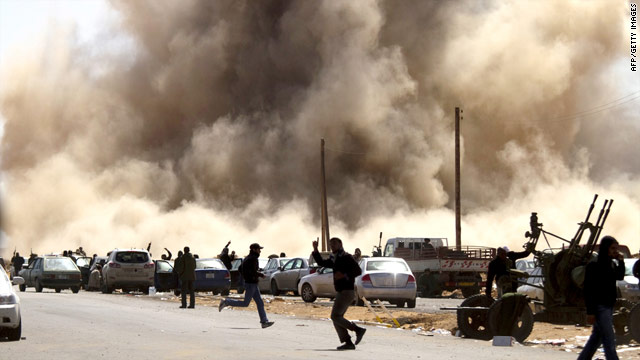
"There's no assurance that the imposition of even a no-fly zone would make a decisive difference in the battle," Burns said. "Gadhafi has ground forces. He has artillery, he has a mercenary army. That's 95 percent of the fighting under way in Libya."
And it would not prove to be a panacea, the head of the U.S. Marine Corps told lawmakers Tuesday. Marine Corps Commandant Gen. James F. Amos said that a no-fly zone would do little to thwart Libya's helicopters, which he called "their greatest threat."A no-fly zone would typically be enforced by fighter jets whose speed and altitude make it difficult to target helicopters, which move low and slow, Amos said.
For its part, Libya said it was not misusing its air force. Any no-fly zone would be tantamount to an act of war, Libyan Deputy Foreign Minister Khalid Karim said Tuesday.
The military, he said, "are taking purely defensive positions; they are not taking offensive ones." He said the Libyan government has asked for international monitors to verify that assertion.
The protests against the 68-year-old Gadhafi began February 15 as anti-government demonstrators sought his ouster after nearly 42 years of rule.
Death toll estimates have ranged from more than 1,000 to as many as 2,000. And the war has forced out 215,000 people, many of them poor migrant workers who have been stranded at both the Tunisian and Egyptian borders, the U.N. refugee agency has said.
While many countries chartered planes and dispatched ships to whisk away their citizens to safety, those stuck at the border are sheltered in cramped, unsanitary quarters with little to eat.
The United Nations' special representative for children and armed conflict, Radhika Coomaraswamy, said her office had received unconfirmed reports of violence against children, "including killing and maiming and use of children as combatants and the denial of humanitarian access."
Valerie Amos, the United Nations under-secretary-general for humanitarian affairs and emergency relief coordinator, called for all Libyan civilians to be protected.
"I am deeply concerned about the reportedly indiscriminate nature of the fighting, and particularly the use of heavy artillery and aerial bombardments," she said in a statement. "We are also hearing reports of hospital closures at the very time when people most need medical care."
The U.N. World Food Programme has initiated a $39.2 million emergency operation intended to provide food to more than 1 million people in Libya, Egypt and Tunisia over a three-month period.
In the latest sign of international solidarity with the Libyan opposition, a group of people entered a home in London Wednesday owned by Saif Gadhafi, the Libyan leader's son who has spoken on behalf of the regime in recent weeks. They could be seen hanging a banner out an upstairs window with a picture of Gadhafi in a red circle with a line through it.
"Out of Libya," the sign says, "Out of London." London Metropolitan police said only the situation was "being treated as a civil matter."
Subscribe to:
Comments (Atom)